

 Photo Credit: Nikita Faie/Instagram
The height of the social media corporate responsibility debate came with the January 6th U.S. Capitol attack, insurrection or whatever you’d like to call it but a new disturbing trend has arisen that Facebook has become forced to address. If you’ve ever added a #Challenge hashtag to a post you were doing, you would know that there is no filter for it. That means you can make a challenge out of anything you want. That’s when the site TooFab discovered the #StabSomeoneChallenge and contacted Facebook about it. The entire challenge feature was then removed.
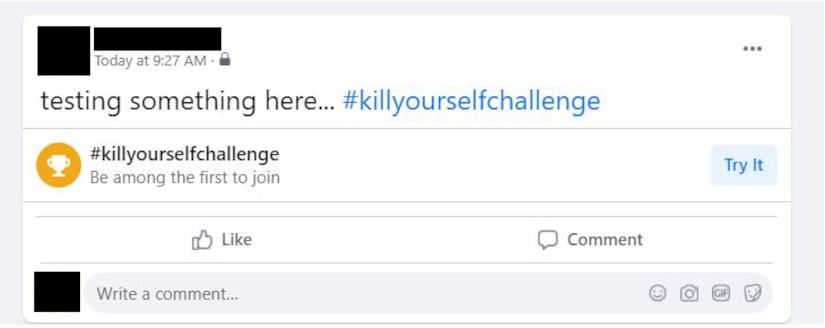 Photo Credit: TooFab
“We have removed this challenge and are limiting this feature while we investigate this issue,” a company spokesperson told TooFab. Also, no additional information was given on why the entire challenge feature itself was removed, but of course one can speculate. It’s only been a few months since its existed and in that time frame, as TooFab pointed out, there’s nothing preventing anyone from making say a #KillYourselfChallenge which even then is followed by a #TryIt button which is all the more terrible.
The Challenge feature was designed to rival TikTok where most of these challenges have originated but has not caught on as much as they would like. And that #TryIt feature is to encourage others to join with the hopes of more viral content on the platform.
This type of oversight is something that Don Heider, Executive Director of the Markkula Center for Applied Ethics at Santa Clara University says he isn’t surprised about, given their past behavior. “Did they anticipate a company could steal people’s personal data and micro-target political ads towards them?” he asked. “Did they predict that foreign governments might use the platform to perpetuate falsities and manipulate public opinion? Did they anticipate when they introduced a live aspect to their platform that a terrorist would livestream a shooting of Muslims in a mosque?”
“If they did anticipate, why didn’t they do something? I think Facebook has not had a great track record in trying to anticipate the harm that can come from their product, and then aggressively taking steps to mitigate that potential harm.”
The Ethics Center helps companies realize the worst possible scenarios technology can be used in. “What obligation does a social media platform — any social media platform — have for what people post on it? This has been the chronic issue with all social media platforms: When do they take responsibility for their role?”
“Just because they have found legal immunity through a fairly big loophole in the law, that doesn’t mean they don’t have moral responsibility, they don’t have ethical responsibility,” he said. “And honestly, more and more people are wondering whether they should have legal responsibility as well.”
He went on to say that one of the more frustrating things is the lack of awareness and response when bad things do in fact happen. “We’re trying to get them to anticipate the problems before they happen, so they can’t be subverted in some horrible way, or used in some way that’s really going to hurt people,” he said. “But in the case of social media companies, they don’t seem to be doing any of this… even when something bad happens, their response is ‘We’re not responsible.'”
“I think there are human beings working at Facebook who care deeply. But the question is: does the CEO care? Do the board of directors care? Do the people at the highest level of the company care? And the answer of course is, if they did, things would change.”
“Negative publicity and scandals don’t seem to hurt their bottom line. They seem a bit impervious to what might destroy other companies. And I think that’s dangerous because it makes you more cavalier.”
He used an example of bad lettuce as a comparison saying, “The thing that’s crazy about social media is we’ve seen strong evidence that they have been complicit in a number of really horrible and harmful situations, and yet their stock price continues to rise.”
He agrees with Apple CEO Tim Cook that more government regulation is likely on the way. “Facebook is a young company — and it’s acting like a young company, in terms of how it thinks about itself, and its responsibility in the world. I think a lot of people are saying it’s time for that particular company — and all the social media companies — to think much more seriously about what effect they are having in the world.”


